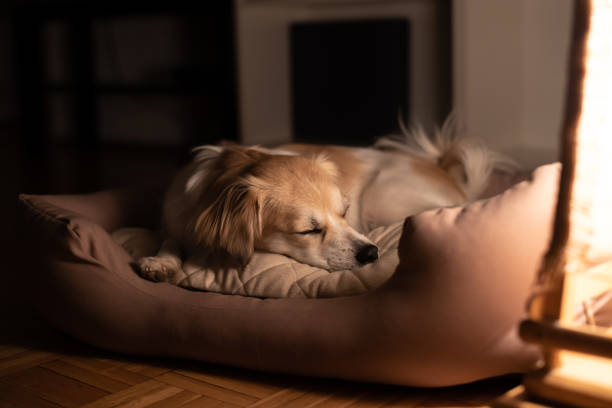
Insight into the dog in the dog bed : What secrets does the dog’s sleeping posture reveal?

If your dog is like a well-trained secret agent, carrying a mission every day, then their sleeping position is the only way you can interpret their instructions. We have all been amused by the cute and strange sleeping positions of our dogs: a furry ball, or lying on their backs with their legs spread out in the air. But these positions are much more than that.
They’re the silent language of your dog’s mood, comfort, and health. Understanding these cues can help you better understand and care for your pet like a true dog whisperer.
In this article, let’s learn the secrets of dog’s sleeping position!
Sleeping Position Interpretation: Five Signals Your Dog Is Telling
1. Classic side-lying position: When your dog is completely relaxed
This is the image you see most often: a dog lying on its side with its limbs stretched out.
This position indicates that your dog feels completely relaxed and secure. When they fall asleep in this position, they typically enter a deep sleep with their body and muscles maximally relaxed.
If your dog often sleeps like this, congratulations, you have created a living environment full of trust and security for it. In order for it to stretch out freely, a spacious, soft dog bed pad or a rectangular dog bed is ideal, which can provide sufficient support for this sleeping position.
2. Curling into a ball: instinctive protection and warmth
This posture is an instinct inherited from dogs’ survival in the wild. They curl up into a compact ball, with their heads tucked under their tails or bodies. This posture serves two main purposes: protecting vital organs like the abdomen and conserving body heat in cold weather.
When I first moved my dog into a new bed, he would always curl up in a ball because he hadn’t fully adapted to the new environment. A donut-shaped or high-sided dog bed would be perfect, providing a huggable feeling and satisfying his instinctive need for a sense of enclosure and security.
3. Upside down: Extreme trust and cooling
This is the most smile-inducing sleeping position. The dog is sprawled on all fours, their belly completely exposed. This signifies the highest level of trust, as they are displaying their most vulnerable parts without reservation.
In addition to trust, this position is also a natural air conditioner for dogs, because there is less hair on the belly, which can help them dissipate heat quickly in hot weather. To allow dogs to lie comfortably on all fours, the dog bed must have excellent ventilation and sufficient space.
A flat, open dog bed allows dogs to sleep comfortably even in the summer. My dog likes this sleeping position the most and seems to enjoy it. It also shows that the dog is relaxed and trusts me and the dog bed.
4. Superman Style: Rest at any time
The front legs are stretched out straight forward, the hind legs are stretched out straight back, and the belly is flat on the ground, like a Superman ready to take off. This posture shows that the dog is resting but not in deep sleep.
They can rise from a resting position in an instant, ready for action. You’ll often see them in this position while napping or after playing.
If the dog likes to lie down in this position directly on the carpet in the living room after playing tired, it tells me that it just wants to take a short rest. This sleeping position requires a flat surface without obstacles, and a spacious dog mat or flat mat dog bed is very suitable.
5. Leaning against a wall/object: Seeking support and a sense of belonging
Your dog will sleep snuggled up against a wall, the edge of a sofa, or on you.
This stems from their pack instincts, and they like to stay close to their companions for a sense of security and warmth. When my friend’s dog comes to play at my house, he especially likes to find the high-sided dog bed I bought for my dog. This is a sign of seeking intimacy and protection.
If your dog bed has a solid back or high sides, it can well imitate this feeling of leaning on it and give your dog a sense of security.
How can you use these clues to choose the most suitable dog bed ?
By understanding the secrets behind these sleeping positions, you can more scientifically choose a dog bed for your dog . A good dog bed is not just about materials and design; it also requires a deep understanding of a dog’s nature. It can support a dog’s sense of security and become their most trusted haven.
If your dog likes to lie on its side or on its back, give priority to choosing a spacious, flat dog mat to ensure that it has enough space to stretch freely.
If he prefers to curl up in a ball, a donut-shaped or high-sided dog bed will give him the greatest sense of security.
If your dog changes sleeping positions frequently, a versatile, adaptable dog bed may be the best choice.
Summarize:
Now, observe your dog and see what its sleeping posture tells you. It is using the simplest way to convey its emotional world to you.