Your dog really care about that old dog bed ? An exploration of the relationship between smell, attachment , and shape.

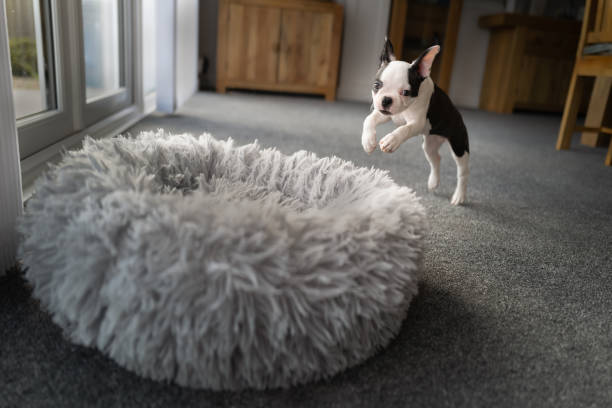
When you finally make up your mind to throw away that worn-out, dog-smelling old bed and replace it with a new, more attractive and supportive one, you might think your dog would be grateful. However, the reality is often that they stand in front of the new bed, wary and uneasy, or even refuse to approach, instead trying to find the old one that has disappeared.
The dog’s cognitive boundaries: Is the old nest missing or does it not exist?
In human cognition, even if you hide a coffee cup in a cupboard, you know it still exists. This is called “object permanence.” But for dogs, their logic of “existence” is different.
A dog’s “living in the present” principle is more focused on the perception and predictability of the current environment. When a key object—like their dog bed —is completely removed from the environment, the dog’s reaction is more like: “My safety anchor has disappeared from this space.”
The anxiety they feel isn’t a logical “where are my possessions?” but an instinctive “my shelter is broken.” It’s difficult for dogs to maintain physical track of an invisible, separate object in their heads the way humans do.
Smell—the GPS of the dog world — is far more dominant for dogs than vision. If the old bed is put away and thoroughly cleaned, even if it’s hidden in an adjacent room, the dog will conclude it’s “functionally non-existent” due to the lack of scent information.
Without scent, there is no security. They cling to the sense of security and identity that scent brings, rather than the sense of ownership of assets in the human sense. Therefore, when the old nest disappears, the dog feels the incompleteness and uncertainty of the environment, which triggers stress.
The Nature of Attachment: A Sensory Game
We can think of a dog’s attachment to his or her den as a game of sensory weighting, in which smell and touch hold absolute power.
Smell (sense of safety) > Comfort (physiological shelter) > Physical shape (visual habit)
Smell: The absolute anchor of attachment , scent is the core basis for a dog’s judgment of “this is mine”. A dog bed is special because it has two key “fragrances”:
Self-identity tag: Dogs use their own scent left by glandular secretions and sebum to mark this as a “safe and occupied” territory.
The dog bed is a “scent cabinet” that collects the owner’s scent (clothing, etc.). For dogs with separation anxiety, the owner’s scent on the bed can ease their emotions and provide strong confirmation that “home” still exists.
Comfort: The Ultimate Satisfaction of Instinctive Needs The second key to attachment is whether the physical attributes of the nest meet their instinctive needs. They are attached to tactile feedback.
Shelter Instinct: Many dogs prefer semi-enclosed, cave-like designs, which satisfy their wild instinct to seek safe shelter.
Physiological support: Whether the material is soft and can disperse joint pressure (especially for older dogs). A dog bed is a “functional tool” that provides high-quality rest and avoids physical pain.
Scientific verification: Which change has the greatest impact on dogs?
We can verify this attachment hierarchy model through a simple nest-changing experiment:
| Scenario | Core variable changes | Dog’s acceptance | Verification results and insights |
| Scenario A: Odor Transfer | Old nest smell + new shape (putting an old blanket into a new nest of a completely different shape) | High acceptance. Dogs usually adapt quickly and start resting in their new nest. | Smell dominates attachment. The presence of scent anchors can effectively cover up the unfamiliarity of shape and vision, quickly rebuilding a safe base. |
| Scenario B: Shape Subversion | The smell of the old nest + subversive shapes such as elevated or hammocks | Moderate adoption, with some hesitation. They hesitate and explore, but eventually adopt. | Their instinctive need for shelter was challenged. The disruptive shape altered their instinctive expectations of a “stable nest,” but the smell ultimately won their trust. |
| Scenario C: Shape unchanged, odor removed | Brand new smell + exact same shape (a thoroughly cleaned, zero-odor replica) | Low acceptance. The dog will be highly sniffing, alert, and even refuse to lie down. | Shape is a secondary cue. Even if the visual is familiar, the absence of smell means “this is not my safe base,” triggering a strong sense of insecurity. |
A few years ago, my dog had an oversized plastic dog bed . It wasn’t pretty, but he’d used it for five years. One day, I decided to give it a thorough clean. I moved the bed to a backyard storage room and replaced it with a brand new, stylish suede bed in his usual spot. I expected him to instantly fall in love with the new bed.
What happened? He ignored the new bed and just kept circling the area where the old nest was, sniffing the floor with his nose.
In conclusion:
A dog’s attachment to its dog bed has nothing to do with human respect for private property, but rather stems from an instinctive pursuit of security and physical comfort anchored by the smell.
Please respect your dog’s preference for a nest that smells strong and even looks a little shabby – it’s not shabby, it’s its sense of security.
What old item does your dog feel most attached to? Does he react to his new litter box with curiosity or rejection? Share your litter-changing strategies in the comments!