
If you have an elderly dog with arthritis or joint pain, you know the heartache. In the mornings, they struggle to get up from the ground; at night, they frequently shift positions, unable to find a comfortable position. The wrong sleeping pad might not only fail to provide rest but also actually exacerbate their pain.
This article will break down the three core dimensions of choosing an arthritis dog bed: support, ergonomic design, and additional features. Together, let’s create a truly comfortable, pain-free safe haven for our elderly friends.

Dimension One: The Secret of the Dog Bed—Support is Key
dog beds filled with plain cotton or rags. For dogs with arthritis, support is far more important than temporary softness.
Why is “professional grade orthopedic foam” your only choice? You can think of an orthopedic dog bed for dogs as a top-notch dog bed for humans. If the dog bed is too soft, your body will sink into it, and your spine and joints will bend and be stressed.
A dog bed with high-density orthopedic foam or specialized support padding—they’re the gold standard. This padding reacts to pressure and contours to your dog’s body (from hips to shoulders), supporting their skeleton like a glove. This eliminates all pressure points between your body and the ground, a key to reducing pain.
Depth requirement: This isn’t an area for compromise. Especially for heavier dogs (like Labradors and German Shepherds), a dog bed must be at least 4 inches (10 cm) thick. If your dog can feel the hard floor beneath them when lying down, the dog bed is ineffective.
Density First: Ensure the selected material is high-density and strong. It can provide better support than ordinary cotton and ensure that it will not collapse after long-term use.
Beware of “sweet traps”: Which materials must be avoided?
When purchasing, please carefully check the filler label. If you see the following words, please avoid:
| Trap Material | Why is it harmful to dogs with arthritis? |
| Flake foam filling/fiber filling | Poor support, quick collapse, and concentrated pressure on joints. |
| Ordinary cotton/polyester fiber | Lacking density, it cannot evenly distribute body weight, resulting in poor rest. |
Dimension 2: Ergonomics—Design determines the convenience of getting in and out of bed
A perfect dog bed should not only be comfortable to lie on but also allow the dog to stand up easily and painlessly after resting.
Lower the height and avoid the risk of jumping. Jumping is the biggest enemy of painful joints. A poorly designed dog bed may make your dog feel like he is climbing a small rock climb every time he lies down and gets up.
Choose a flat or low edge: Make sure the edge of the dog bed is low enough for your dog to step into.
My experience (from the author’s perspective): A few years ago, when my golden retriever began experiencing hip problems, I immediately removed all the high beds. I installed pet ramps or steps next to the sofa and bed. A good orthopedic bed should be at the same height as these assistive devices, creating an accessible rest area.
Many high-end orthopedic beds have wraparound or sofa-style raised edges called “support bolsters.”
Spine Alignment: These edges are perfect for head and neck support. They allow your dog to rest their head comfortably, helping to maintain a straight spine and neck alignment, which is key to deep relaxation.
Nesting provides a sense of security: This feeling of being surrounded satisfies a dog’s natural nesting instinct and is especially soothing to dogs that are anxious or distressed due to pain.
Space: Stretching is part of self-healing. Arthritic dogs need to change their sleeping positions frequently to relieve pressure in one area. If the dog bed is too small, they will be forced to curl up in a fixed position. Make sure the dog bed is large enough for your dog to fully stretch out, lie on his side, and roll comfortably.
Dimension Three: Enhanced Comfort and Hygiene
Choosing a dog bed, don’t overlook the additional features that can enhance comfort and simplify daily care.
Warm Therapy: The Miracle of Electric Heating You may know that applying heat can relieve muscle soreness. The same principle applies to dogs.
Relieve stiffness: A pet-specific electrically heated dog bed or heating pad can provide a low, safe, constant temperature, helping to relax the muscles around the joints and relieve morning stiffness and pain. This is especially important in winter or in cold regions.
Safety Tip: Always choose pet-specific heating products that are certified for safety and have automatic power-off and temperature control functions to prevent burns.
Location: Place the dog bed in a warm, draft-free corner of the room to maximize its thermal insulation.
H3: Waterproof and easy to clean: Essential requirements for senior dogs
Elderly or sick dogs may face the problem of incontinence. A dog bed that is difficult to clean is not only unhygienic but also expensive to replace.
Machine-washable covers are mandatory: Covers must be removable and machine washable.
Waterproof Liner: This is key to protecting the orthopedic filling! Look for a product with a **waterproof liner**. This layer of protection prevents liquids from seeping into the core filling, ensuring the dog bed is hygienic and long-lasting.
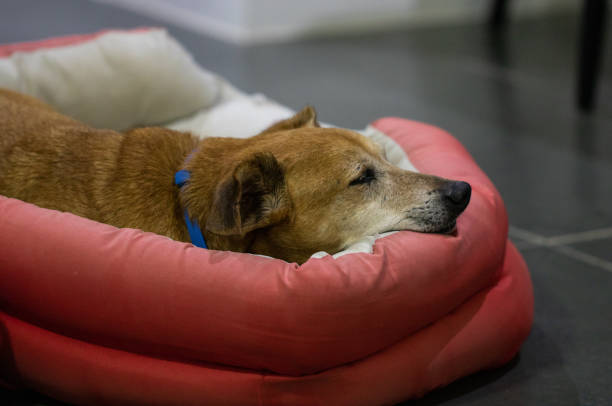
Conclusion: No longer just a dog bed, but an investment in your health
A dog bed for a dog with arthritis is a loving task that requires the same care as choosing your own dog bed. Consider it a crucial investment in your dog’s health and well-being in their later years.
A proper orthopedic dog bed can significantly improve their sleep quality and mood and ultimately extend their vibrant life.
Has your dog’s arthritis been alleviated? Why not try a different dog bed?