
As pets become important members of the family, dogs’ social lives are receiving increasing attention. Many dog owners are discovering that a comfortable dog bed is not only a resting space but can also play an unexpected role in social activities. From pet park gatherings to family pet parties, how does a dog bed affect a dog’s interaction and mental health?

Dog bed: more than just a place to sleep
Many people think that a dog bed is just a place for dogs to rest and sleep, but in reality, its function is much more than that:
Psychological security: A dog bed is a dog’s “territory,” providing a sense of security in unfamiliar environments and allowing them to explore their surroundings more confidently.
Comfortable rest: After socializing, dogs need a quiet, soft place to recover their energy.
Behavior management: When dogs are overly excited or stressed during activities, can serve as a space for self-regulation.
Studies have shown that dogs with designated rest areas are more stable in social activities and exhibit less aggressive or withdrawn behavior.
The dog bed’s role in social activities
In pet social settings, they serve multiple purposes:
1. Provide a safe buffer zone
When a dog first meets a new friend or other dog, it may show signs of nervousness or anxiety. At this time:
Become a safe zone that can be retreated to at any time
Dogs can observe their environment from inside their kennels and gradually adapt to new social objects.
Reduce direct conflict and excessive excitement to avoid accidental injury.
2. Promote positive interaction
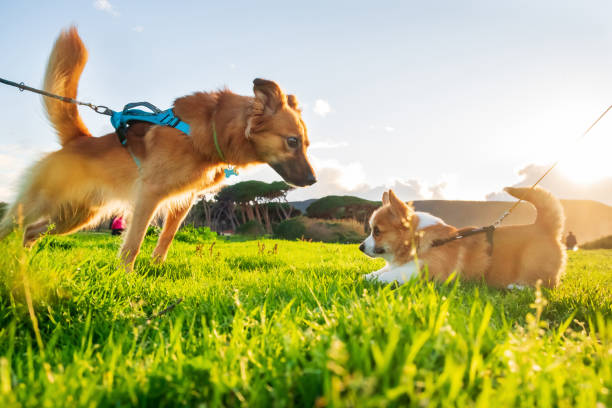
Some dogs enjoy inviting their companions to play or rest together. A comfortable dog bed is essential.
It can become a “base” for dogs to play together.
Encourage gentle interactions, such as lying together near the nest or taking turns resting.
Help your dog establish social rules and learn to share space.
One pet owner shared that his two Golden Retrievers take turns resting on the same dog bed, observing and interacting with each other, gradually forming a tacit understanding.
3. Strengthen the bond between owner and dog
It’s not just a space for dogs but also a medium for interaction between owners and their dogs:
Owners can guide their dogs back to their kennels during social activities, rewarding them and providing positive reinforcement.
Use a dog bed to train social etiquette, such as waiting and resting quietly.
Teach your dog to maintain its own pace in social situations without relying on constant intervention from its owner.
This approach helps boost a dog’s social confidence while reducing stress during activities.
Matching shopping with social activities
Different social situations require different dog beds:
For pet parks or outdoor activities: Portable, easy-to-clean, and durable dog beds are more suitable for mobile use.
Family pet gatherings: A comfortable, soft bed with a fence or high sides makes your dog feel safe.
Large dog parties: A large or partitioned dog bed can accommodate multiple dogs while maintaining their individual spaces.
Choosing the right dog bed not only enhances the dog’s social experience but also helps them maintain psychological balance during activities.
Psychological and behavioral benefits of social activities
Social activities bring numerous psychological and behavioral benefits:
Reduce anxiety and tension: Having a designated space allows dogs to regulate their emotions on their own.
Boosting self-confidence: An increased sense of security makes dogs more willing to approach other dogs.
Establishing social rules: By taking turns using the dog’s kennel or waiting near it, dogs learn to share and interact politely.
Pet behavior studies show that dogs with stable safety zones exhibit significantly lower frequencies of aggression or withdrawal during group activities.
Combining daily use with activities
In daily life, owners can incorporate the dog bed into socialization training:
Phased socialization training: Start with short-term socialization simulations at home using a dog bed, then gradually expand to parks or pet parties.
Positive reward mechanism: Give the dog treats or petting after it returns to its kennel to create positive associations.
Observe behavioral changes: Record the dog’s behavior in its kennel and social environment, and adjust the training pace accordingly.
My friend arranged two dog beds for his pet’s birthday party, allowing small and large dogs to use their own, which made the whole event more harmonious and the dogs more relaxed.
Summarize:
A dog bed is not only a resting place for dogs but also an indispensable psychological and behavioral tool in pet social activities. By providing a safe and comfortable space, a dog bed can:
Relieve anxiety and tension
Promote positive interaction and social skills development
Enhance the interaction experience between owners and dogs.
When choosing a dog bed, you should consider the type of social activities, the dog’s personality, and the number of dogs to ensure that the space is suitable, safe, and comfortable.
If you want your dog to be more confident and happier in social activities, you can start by choosing a suitable dog bed, making it a “little helper” for your pet’s social experience.
Dog bed now to enhance your dog’s social experience.