Scientific analysis: How to upgrade your dog bed for summer ? Ventilation, cooling, and structural secrets

With the arrival of summer heat waves, how can you create a comfortable dog bed for your dog? Their little nest, which should be a safe haven, can become a deadly heat trap.
A friend of mine experienced this last summer. Her dog spent most of its time in a kennel in the shade of their yard. One day, the dog started panting heavily and looking listless. The vet diagnosed it with mild heatstroke! My friend was perplexed: “How could this happen when the kennel is in the shade?”
The truth is: shade can’t solve the problem of poor ventilation and heat accumulation from the ground. Dogs mainly lose heat through panting and paw pads. If there is no air circulation, body heat will be trapped in a small space.
This article will peel back the scientific aspects of summer dog bed design and teach you how to create a truly cool summer home for your furry friend by optimizing materials and structures like an engineer.
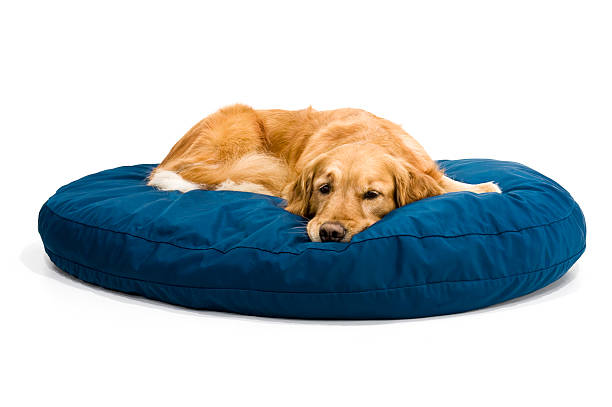
Solve the underlying problem: cut off the heat source and optimize the contact surface
A cool dog bed starts by cutting out two major sources of heat: heat from the ground, and heat between your dog’s body and the mattress.
Physical isolation: Raising the ground to create an insulating air cushion
your dog bed placed directly on concrete or grass? If so, you’re essentially placing the bed on a massive heat-storage plate. The ground, heated during the day, continuously transfers heat to the dog bed floor, creating an invisible heat source even at night.
Scientific countermeasures: Block this conduction by raising the bottom of the dog bed. Raise the dog bed by 2 to 4 inches (about 5-10 cm) to allow air to flow freely at the bottom of the dog bed .
Embrace cooling technology: Choose a mattress that dissipates heat efficiently
Traditional cotton or down mattresses are great for keeping you warm in the winter, but in the summer, they’re just insulating walls against heat.
TPE or gel inner pad: Consider replacing the inner pad with a high-density, low-heat-absorbing material, such as TPE material with a hollow structure inside, or a built-in cooling gel pad.
Tip: Gel pads cool down by absorbing body heat. When they become saturated, they warm up and need time to recover. Therefore, they are more effective when used with a well-ventilated structure.
An all-around solution: If you want a bed that adapts to all temperature changes, consider a dog bed made of breathable materials and designed for all seasons. These effectively dissipate heat in the summer, keeping your dog feeling as cool as a summer sofa, while their materials and construction provide warmth in the winter.
Structural upgrade: achieving passive cooling
It is not enough to have shade, you must also allow hot air to escape. The core of heat dissipation is to establish an efficient air convection system.
Low in, high out: Physics tells us that hot air rises, and cold air falls. A well-designed dog bed takes advantage of this principle, also known as the chimney effect:
Low-position air intake: Make sure there is enough opening on the bottom side wall of the dog bed or below the door to allow denser, relatively cooler air to enter.
High-Level Exhaust Vents: Vents or transoms are located at the edge of the roof, under the eaves, or at the top of the side walls. These allow hot air that collects at the top to escape.
the dog bed is continuously extracted and new, cooler air is introduced to achieve circulating ventilation and keep the internal environment “fresh”.
Semi-enclosed structure that takes into account both safety and ventilation
Even for indoor dog beds , ventilation is key. Some pet beds use clever structural designs, such as semi-enclosed designs. This design has two huge benefits for small and medium-sized dogs:
Sense of security: It provides a cave-like wrapping feeling, which satisfies the pet’s instinct to seek shelter and is very suitable as their exclusive sleeping space.
Keep ventilation: Different from the fully enclosed dog bed , the semi-enclosed design provides a sense of security while ensuring that the opening on the top is large enough to allow heat and moisture to dissipate, perfectly meeting the needs of coolness in spring and summer and warmth in autumn and winter.
Conclusion:
Our love for pets is reflected in every detail. A well-designed dog bed is not only about making your dog comfortable, but also about taking responsibility for its health and life.
When you follow scientific structural and material principles, elevate the base to cut off ground heat, and utilize the chimney effect to ensure continuous ventilation, you’ve truly created a safe summer haven for your dog. Furthermore, a dog bed that combines all-season adaptability, breathability, and warmth (often available in multiple sizes for creating multiple-sized pet sleeping areas) is an excellent choice for pet owners to create a comfortable sleeping environment for their furry friends, allowing you to completely say goodbye to seasonal anxiety.
Next time you enjoy the air conditioning, make sure your furry friend gets a little cool down with the help of science, too.
Is your dog’s bed ready for summer? What upgrades are you most excited to try? Share your summertime tips in the comments!