The Ultimate Guide to Dog Sleep: How to Improve Your Dog’s Environment, Body, and Mind for Optimal Rest

If your dog is cranky, restless, or constantly napping during the day and pacing at night, there’s definitely something wrong with your sleep quality. Just like people, dogs who get enough rest are healthier, happier, and more well-behaved.
However, dogs’ sleep cycles are fundamentally different from ours. They’re naturally intermittent sleepers—they nap briefly, wake frequently, and must feel fully secure to enter a deep rest. This means that getting them a good night’s sleep is a strategic endeavor involving three core pillars: environmental, physiological, and psychological.
Understanding Canine Sleep Cycles: Intermittent Sleepers
Before you can solve the problem, you need to understand your dog’s natural rhythm. Napping habits: Why they can’t sleep for 8 hours straight
Total sleep time: Adult dogs need more rest than humans, averaging 12 to 14 hours per day. Puppies and older dogs need even more, requiring 16 to 20 hours per day.
Alertness: Dogs have evolved to sleep in short bursts, constantly switching between light sleep and alertness. They only truly relax when they are not required to guard or observe their surroundings.
Two important stages of rest
Deep Sleep: This is the restorative sleep stage. You may see your dog twitching, gently flapping their paws, or making soft sounds (“dreaming”). This stage is crucial for memory consolidation (reinforcing training!) and emotional regulation.
Light sleep/rest: They spend most of their time in this stage. The goal is to shift that balance: the more secure they feel, the more likely they are to transition from light sleep, wakeful rest, to true deep REM sleep.
Cracking the Environment: Building the Ultimate Safe Haven
your dog ‘s bed is the biggest factor in determining its initial comfort.
Dog bed settings: comfort, support, and temperature control
Size and style: The dog bed must be fully extendable, curlable, and easily repositionable. If your dog likes to burrow, choose a cave-style or donut-style dog bed . If your dog likes to sprawl, choose an open orthopedic dog bed for optimal joint support.
Material and heat: Dogs get hot easily. The enemy of deep sleep is overheating.
Prioritize breathability: Avoid heavy, synthetic polyester fiberfills, which tend to trap heat. Opt for a dog bed pad with cooling properties or a breathable cover.
The power of choice: Dogs will move around their beds depending on temperature and household activities . Set up 2-3 different resting spots in the house (e.g., a cool tiled corner, a cozy bedroom rug, a cage) to give them space to move around.
Strategic Placement: Quiet Zone Rule Close to You, Away from Danger: Dogs are social sleepers who need to hear and feel your presence. Place the dog bed near the bedroom or in a quiet corner of the living room, but… avoid a “guard station”: Never place the main dog bed directly next to the front door or a window overlooking a busy street. This forces your dog to act like a 24/7 home security guard, alert to every sound and preventing him from getting a deep rest.
Nesting effect: If using a crate, simulate the effect of a nest by covering the top and sides with blankets or towels. This blocks visual stimuli and creates the private, dark space necessary for safety.
Sound and light: Optimize your microclimate. White noise strategy: If your house is too quiet, any subtle squeak, car horn, or neighbor’s siren can startle you. Playing soft white noise or gentle classical music can soften sudden noises and reduce the chances of being suddenly awakened.
Ideal Temperature: Keep room temperature comfortable—usually slightly cooler than humans prefer. Good ventilation is key to preventing your dog from overheating in their cocoon.
Psychological comfort: interpersonal relationships
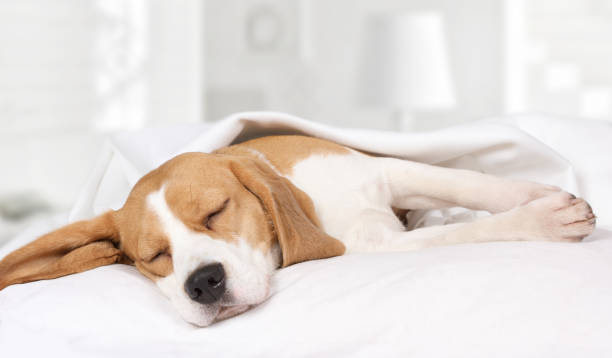
Safety is the ultimate way to help your dog sleep. If your dog doesn’t feel safe, no matter how soft the dog bed pad is, it will be of no use.
Harness the power of scent with a scent security blanket: Place an item with your scent (such as an old T-shirt or pillowcase) on your dog’s bed or in his or her cage. This familiar scent will mimic your presence and be incredibly reassuring, especially for newly adopted or anxious dogs.
The dog I rescued cried constantly at night when I first brought her home. I put my old, unwashed sweatshirt in her crate and it stopped her crying immediately. My scent was all the reassurance she needed.
Managing Physiological and Attention-Seeking Nighttime Wakings and Crying: Distinguishing between a genuine need to go out and attention-seeking.
Potty Procedure: If you suspect your child needs to go to the bathroom, take them out quietly and quickly. No talking, no eye contact, and no playing. As soon as your child is done using the bathroom, go straight back to the dog bed .
Attention Protocol: If you know they’re seeking attention, ignore their whimpering (as long as it’s safe to do so). If you must respond, use only calm, low-pitched reassurance (“Quiet for a minute,” “Go to sleep”), but don’t turn on the lights or pet them. You must avoid reinforcing “cry and hold” behavior.
In conclusion:
Ensuring your dog’s sleep is one of the most important responsibilities of a pet owner. It’s a comprehensive system: a suitable environment provides physical comfort, a regular sleep schedule provides structure, and your quiet presence provides psychological security.
Work hard to establish this secure foundation for sleep, and your reward will be a less anxious, better-behaved dog who’s ready to happily take on the day.
Where does your dog always insist on sleeping? Do you have a unique “goodnight ritual” to keep your dog quiet? Share your best sleep hacks in the comments!