
When buying a dog bed for the first time, many people consider size, material, and ease of washing, but few seriously think about color. They
end up carefully choosing a dark gray, dark green dog bed that looks like it won’t get dirty—only to find their dog running back to their light beige blanket and sleeping soundly.
If you’ve noticed that your dog seems to prefer light-colored dog beds, sofas, and blankets, it’s not just a coincidence or something you’re overthinking. From a sense of security and instinctive memory to the emotional connection with their owner, light-colored dog beds are indeed more likely to appeal to some dogs.

In a dog’s eyes, light colors equal a more controllable and safer space.
Being able to see clearly is itself a sense of security.
Dogs’ ancestors were accustomed to resting in caves and dens, and they would instinctively assess a location:
Is there any foreign object?
Are there any insects or small, sharp objects?
Has the environment suddenly changed?
For dogs, places that are clearly visible at a glance are more likely to be perceived as “safe.”
Light-colored dog beds score highly in this regard.
Dust, debris, and small insects are more noticeable on light-colored fabrics.
The dog can more easily “scan” the room to make sure there are no strange things in it.
Especially for dogs that are inherently sensitive and prone to anxiety (such as Pomeranians, Poodles, and Corgis), they are particularly concerned about “visible safety.”
You may have seen similar scenes: many dogs will choose to lie on the brighter side of the sofa or a lighter-colored patch of carpet—that’s not random, but they are actively choosing areas where they can see clearly.
Shadows and dark colors: to a timid puppy, it’s like “unknown territory.”
For some dogs, dark areas are easily perceived as:
This doesn’t mean that dark-colored dog beds are necessarily “scary,” but rather that for dogs that are already timid or highly alert, a dark space is more like a place that requires extra effort to confirm.
In contrast, light-colored dog beds are visually more “open”: there are no hidden shadows, naturally making them feel more at ease approaching and lying down.
Lighter colors are actually closer to the natural dens that dogs remember.
Where do dogs prefer to lie down in the wild or in environments closer to nature?
Haystack
sandy land
Dried leaf pile
Earthy, light yellow, and light brown ground
These places all have one thing in common: they are mostly light-colored or neutral-colored, and they look soft, dry, and warm.
When you prepare a light beige, light khaki, or cream-colored dog bed for your dog, it may just be “part of a Scandinavian-style home” to humans, but for dogs, it’s likely to evoke associations with natural, safe den colors.
“This place looks like a good place to lie down and rest.”
This isn’t rational thinking but rather a near-instinctive preference—light colors visually resemble “safe ground” and “comfortable nest.”
Lighting and comfort: Lighter colors are more suitable as a sleeping background.
Light colors are less likely to create a “black hole effect.”
Dark surfaces, under uneven lighting, can easily appear as a deeper, darker hole.
Lighter surfaces, on the other hand, reflect light more softly, making the entire area look:
Not so “oppressive”
Not so “dark”
Less irritating to the eyes
For some dogs with sensitive eyes (including many white or light-colored breeds such as Samoyeds and Maltese), a space with soft lighting is more conducive to their relaxation.
Light-colored dog beds are often considered more “suitable for sleeping.”
In terms of sleep environment, humans seek:
Non-glaring, flicker-free light
The overall atmosphere is soft and quiet.
Dogs don’t need you to turn on ambient lighting for them, but the overall visual feel of the area can definitely influence whether they’re willing to sleep there all night. A light-colored dog bed, in most home lighting environments, often creates a quiet, soft corner, perfect for sleeping.
Dogs are actually copying their owners’ home decor style.
Another often overlooked factor is that the owner’s preferences gradually become the dog’s “default environment.”
In many modern homes, especially in North America, Europe, and parts of Asia, the living room and bedroom often look like this:
Light-colored sofa
Light-colored bedsheets
Cream-colored rug, beige throw pillows
A neutral space featuring natural wood and white walls.
Dogs get used to rolling around, sleeping, and cuddling in these areas from a young age—
In other words, they associate these light-colored areas with the scent of their family members and the “places where they often spend time together” from the very beginning.
dog bed in a similarly light color:
For you, it’s about being “easy to match, looking good, and being great for taking photos.”
For dogs, it’s about “this place looks similar to their owner’s house” and “this place should be safe.”
This preference learned from the environment is somewhat like how humans tend to prefer spaces with colors similar to those in their childhood rooms—it’s not an absolute determining factor, but it has a subconscious positive effect.
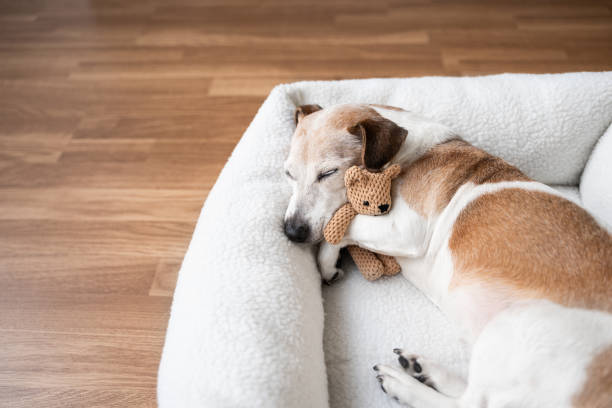
Territoriality: On a light-colored dog bed, they can see their own fur.
Dogs use both smell and sight to identify their territory:
Scent: My own scent, the scent of familiar people and things
Visually: Seeing “This is a place I often stay in” and “This place holds traces of my own.”
Light-colored fabrics have an interesting characteristic: they shed more noticeably.
For humans, this is a minor inconvenience when cleaning;
but for dogs, it’s actually “evidence”—
This is where my fur is, this is where my scent is, this is my place.
When the dog bed is a lighter color:
Dogs can see their own fur more easily.
Combining scent information makes it easier to recognize this place as a stable, private space.
A strong sense of territory leads to a greater sense of security, making people more willing to stay there for longer periods.
This is why some dogs will stubbornly return to the same light-colored mat or carpet to sleep—it’s not random, but rather they’ve “registered” that place as their bed.
Conclusion:
In summary, many dogs prefer light-colored dog beds, often because:
Light-colored spaces make it easier for them to “confirm safety.”
Lighter colors are closer to the natural nests and comfortable floors of our memories.
A light-colored dog bed is more appealing in terms of lighting, mood, and territoriality.
It sounds very “psychological,” but in everyday life, it boils down to one sentence:
Dogs often prefer places where they feel safe, familiar, and relaxed. Color is just one small but relevant clue.
You can also share in the comments section:
Where does your dog like to sleep? Is it in a light-colored area, or in some corner you would never expect?