a dog bed in a multi-story house: allowing the dog to rest peacefully and reducing the need for frequent bed changes.

More and more people are living in multi-story residential buildings, especially duplexes, apartments, or townhouses. The rich spatial hierarchy and complex circulation seem to bring convenience to life, but they also often cause a detail to be overlooked—where is the most suitable place to put a dog bed?
Many pet-owning families encounter similar problems: they buy a dog bed and put it on the first floor, but the dog always runs to the corner on the second floor to sleep, or it is almost useless in the living room during the day, but at night it insists on squeezing in by the stairs.

What are the differences in location requirements between multi-story residential buildings and single-story residential buildings?
In single-story houses, location selection is relatively simple, usually revolving around the principles of “quiet, undisturbed, and close to family.” However, multi-story houses add the variable of floors, making the situation much more complicated.
The height of a building can affect a dog’s sense of security.
For dogs, different floors represent different levels of “control.”
Some dogs prefer to stay in areas where they can see their family members, while others prefer relatively secluded and quiet corners.
If a dog bed is placed on a floor where the dog doesn’t often go, it’s easy for it to be “neglected,” and even if the bed itself is very comfortable, it’s difficult to form a long-term habit of using it.
Complex traffic flow and incorrect positioning can easily cause stress.
Multi-story residential buildings typically have stairs, elevators, or corner spaces. If the dog bed is placed in:
stairwell
The passageway where people frequently go up and down stairs
A narrow passage that family members must pass through
These will frequently disturb the dog while it is resting, and over time, the dog will actively avoid this dog bed.
Before determining the ideal location, observe the dog’s actual behavior.
deciding which level to place the dog bed on, there is a very important but often overlooked step: observe where the dog chooses to rest.
Where do dogs most often “sleep spontaneously”?
Please pay attention to the following issues:
Which floor do dogs usually lie on during the day?
After the family activities are over in the evening, which floor will it choose to rest on?
Are there any fixed corners that are repeatedly used?
These behaviors are often more real than the “theoretically suitable place.”
My house has two floors. At first, I put the dog bed in the corner of the living room on the first floor, thinking it would be convenient to keep an eye on it. But after a while, I found that the dog would run to the carpet by the door of the study on the second floor to sleep every afternoon. Later, I moved the dog bed to the same floor, and its usage frequency increased significantly.
Four most common layout schemes in multi-story residential buildings
Option 1: Place a dog bed on the main activity floor (most common option)
The main active layer typically refers to
The floor where the living room is located
The area where family members are most active during the day
This is the preferred location for most families when choosing a dog bed.
advantage:
Dogs feel safer when they can see their family members at all times.
It is easy to form “fixed rest points.”
Not easily forgotten or left unused
Precautions:
Avoid facing the TV or speakers directly.
Do not sit too close to the aisle or the side of the sofa.
If you choose to place the dog bed on this floor, it is recommended to place it in a location where you can see your family members but it will not be frequently stepped on.

Option 2: Set the sleeping floor for nighttime use
Some families will place an extra dog bed on the floor where the bedroom is located for nighttime use.
This approach is particularly suitable for:
clingy dogs
Dogs sensitive to environmental changes
Dogs prone to nighttime anxiety
The nighttime location should meet the following requirements:
It’s close to the bedroom but doesn’t block the door.
away from the stairwell
Soft light, quiet
I later added a simple dog bed for the dog in the hallway outside the second-floor bedroom, and I found that it was much more peaceful at night and no longer went up and down the stairs so frequently.
One main dog bed and one auxiliary dog bed are set up.
If space allows, placing one on each of the two floors is an ideal solution.
First floor: for rest and companionship during the day.
Second floor: For use at night or when quiet.
The advantages of doing this are
Adapt to your dog’s changing sleep patterns
Reduce physical exertion when going up and down stairs
Avoid forcing your dog to “only recognize one spot.”
It’s important to note that the materials and comfort levels of the two dog beds shouldn’t differ too much; otherwise, the dog will develop a long-term preference for one of them.
Option 4: Avoid placing the dog bed on stairs or in mezzanine spaces.
Many multi-story residential buildings will have:
Staircase corner
Mezzanine platform
corridor space
These spots may seem empty, but they are actually not suitable for a dog bed.
Reasons include:
Strong sound reflection, easily startled
Large airflow between floors
Psychologically lacking a sense of “closed-offness”
Dogs that rest in this position for extended periods are prone to having shallow sleep and excessive alertness.
From an environmental perspective, which locations would discourage dogs from using the facilities?
Even if the floor is chosen correctly, an unsuitable location can still affect the dog bed’s usability.
Locations with large temperature variations
In multi-story residential buildings, the following areas exhibit significant temperature differences:
Near the floor-to-ceiling window
Below the air conditioner vent
stairwell
your dog bed is placed in these locations, your dog may:
Feeling cold in summer
Afraid of wind in winter
Locations with excessive visual pressure
Some families place the dog bed in the “most conspicuous place,” but for the dog:
Frequently watched
I am often disturbed by passers-by
On the contrary, it will reduce the quality of rest.
Ideally, one could see their family members but not be the center of attention.
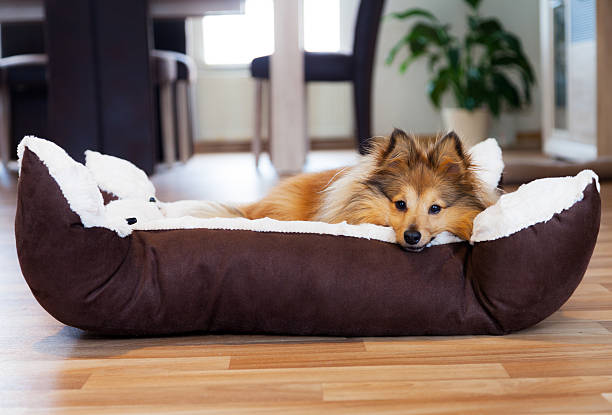
Different types of dogs have different preferences for different floors.
1. Older dogs
suggestion:
Reduce going up and down stairs
Placed on the main living floor
Avoid going near the stairs
This can reduce joint pressure.
2. Energetic, follower-loving dogs
These types of dogs are usually more willing to:
Activities with family
Rest in the main public spaces
A dog bed is more suitable for placement on the floor where the living room or study is located.
3. Dogs with sensitive and highly alert personalities.
More suitable for:
Quiet floors
against the wall, in the corner
Stable and unchanging position
Frequent movement will only exacerbate their anxiety.
Once the location is chosen, is it necessary to frequently adjust it?
Many people ask:
“Should the dog bed be moved around frequently to help the dog get used to it?”
The answer is usually: frequent adjustments are not recommended.
For dogs, a dog bed is more than just a place to sleep; it’s also a “safe haven.” Once the position is stable:
Dogs relax more easily
Falling asleep faster
More frequent use
Unless there is significant discomfort (noise, temperature, or changes in family structure), try to keep the dog bed in a stable position for a long period of time.
Conclusion:
In multi-story residential buildings, there is no single answer to the ideal location, but there are certainly “choices that are more suitable for your dog.”
dog bed that better fits your body’s movement, provides better support, and offers a more enveloping feel.
dog bed suitable for multi-story homes so your dog can rest comfortably on every floor. Pick a dog bed now that’s truly “rightly positioned and comfortable for your dog to sleep in.”